

All of Your Documents from All of Your Customers, Members & Accounts
Manage customer, member, loan, deposit, trust, and back-office documents in an intuitive, core-integrated document imaging system that’s built for banks and credit unions.
DOCUMENT MANAGEMENT
View and Share Documents in a Variety of Ways
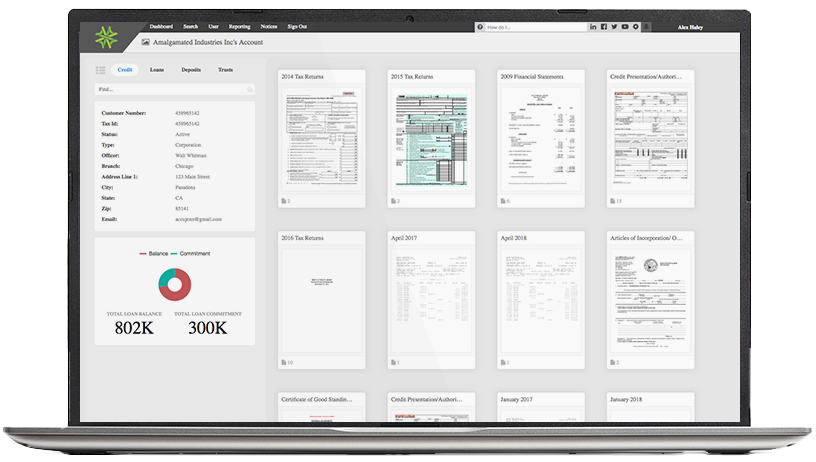
Enable users to view documents in ways that streamline their jobs. "Document view" provides lenders with a visual way to explore and search customer and member documents. "Teller view" gives tellers and front-line staff the quick answers they need to support their account holders. "Customer view" provides a 360-degree perspective for back-office and administrative staff.
NEW ACCOUNT SCANNING
Scan and Index a Massive Stack of Paper in Minutes, Not Hours
Accelerate customer, member, and account onboarding with barcodes and batch scanning. Barcoded documents simplify the preparation of loan files and speed up scanning. Use accuimg to efficiently manage batch-scanned documents, attorney-prepared loan files, financial statements, applications, and much more. Spend fewer resources and less time scanning documents.

TRAILING DOCUMENTS
Drag and Drop PDFs, Images, and Email Attachments
Simplify the management of trailing documents, such as quarterly and annual financial statements from account holders, tax returns, flood zone determinations, deeds of trust, UCCs, and insurance. Exception reports help you identify trailing documents that are missing. Drag and drop electronic files into an intuitive user interface.
THIRD-PARTY INTEGRATIONS
eSign, LOS, and Other Tools
Automatically pull in documents directly from your LOS (loan origination system) or eSign products through a nightly process. Easily drag and drop documents from your portal to AccuAccount. Enable an easier way to collect documents from account holders. Reduce paper at every step of the process and increase customer and member satisfaction.
CORE INTEGRATION
Streamline Document Management with Integration to 30+ Core Systems
Eliminate manual data entry by integrating AccuAccount to your core banking system. As new customers, members and accounts are booked to the core, AccuAccount automatically creates placeholder records. Know exactly where each document should go without relying on manual ticklers, spreadsheets, and checklists. Gain a structured approach to document management.

TRACKING & REPORTING
Integrate Imaging and Tracking for Greater Efficiency
Built-in document tracking maximizes the impact of your imaging workflow. Exceptions automatically clear as new documents are scanned or uploaded into AccuAccount. Trigger new exceptions automatically based on the customer, member, or account type. Data-driven exception reports and email alerts keep everyone informed. Build reports by officer, account type, and other criteria with Dynamic Reporting in AccuAccount.
Additional Imaging Resources
Take the Next Step
From quality control to participations to audit and exam prep, we've only scratched the surface of what AccuAccount can do for your financial institution. Watch a pre-recorded webinar, download a whitepaper, or check out our FAQs to learn more about our software.
Hello, and thank you all for joining us today. My name is Kara Topcot. I am the Marketing Communications Coordinator here at Alligent. Welcome to the second installment of our AccuAccount Live webinar series. If you missed the first one, you can view a recording of it on our website. As for today's session, we're gonna be going over AccuAccount's imaging workflow capabilities and how they can support greater visibility and cleaner files across all departments. We have a wonderful speaker here with us today, Jamie Biggs, Alligent's sales manager for AccuAccount. If any questions come up during the webinar, please feel free to type them into the chat box. We'll have a designated Q and A segment to answer any of those at the end. And with that, I'm gonna hand things over to Jamie. Thank you, Kara. Good afternoon, everyone. I'm Jamie Biggs. I've been with the company for about seventeen years. So if you have any questions, as Kara said, as I go through the presentation today, feel free to reach out and ask. I'll be happy to get those answered. And I'm going go ahead and jump right in. Just really quickly wanted to remind you of the series that we're doing. We did do Life of the Loan back on January twenty second, so we have that recording available. Today, we're going to be going over your imaging options within AccuAccount, and next week, we'll be going through all of the tracking features that are available along with reporting. So, a high level overview of what AccuAccount is. It is a loan management and exception tracking system. So, we support about one hundred and eighty banks currently. It is a core integrated solution that supports the life of the loan. We have worked with community banks and credit unions over the years to take feature requests, see what they are wanting to use as far as tracking and imaging goes. And we've really built the software around those features. We still take feature requests to this day and continue to build onto that software. We use the system with unlimited users at your financial institution to view your document images, track missing exceptions, expired exceptions, and quite a few others that we'll touch on today. So, first of all, I just want to talk about how we get this data into AccuAccount. We integrate with your core system and bring over your data nightly so that we stay in sync with your core. So, anytime you have a customer or a member updated with the loan collateral information, This can also be used for deposit and trust accounts as well, but we will bring that in so you never have to do any maintenance or add anything manually into the system. We can also integrate with eSign products and LOS systems. So, if you're wanting to bring in data or images from those systems, we can do that automatically. Our big focus today is over imaging. So, we're going to talk about all the different ways that you can image into the software. Our exception tracking, so we have multiple ways to track exceptions. We have what we call integrated exception tracking. So, we actually look at the document information to track your exceptions, so you aren't having to go in and update exception information manually or add anything into the system. And then we have many reports out there that are available for your exception reports, data reports, system reports, really anything that you want to pull out of the system is going to be available for you. So, looking at the imaging options that you have available, there are several ways that you can get those into the system. We do offer barcode scanning, so we can either produce barcodes from within AccuAccount to do your scanning, or you can use third party barcodes. We offer batch scanning, which is probably the quickest way to bulk scan into the system. You can actually put in an entire file. It could be multiple customers, multiple loans, collaterals, scan them all in on a multifunction device to one PDF, and then break that document apart with our product called Accu Image. So, there's a document editing program that allows you to quickly identify your documents and save them in the correct location, and we will look at that today during the demo. You have single scan options for trailing documents. If you have a desktop scanner, you can quickly scan those items right to the location they need to be synced in the customer's page. We offer drag and drop, so anytime you have something that's already in an electronic format, something gets emailed to you, you can very easily take that over and just drag and drop it where it needs to be saved. And then our final option listed here is AccuPrint. So, this allows users that do not have access into AccuAccount typically this would be your lenders or somebody that is just receiving documents that they can print the document through AccuPrint, and it puts that document into a holding location for review. So, somebody that does have editing permissions can go in, review that document, and then push it to the location on customer's page where it needs to be saved. We'll also take a look at that during the demo today. So, a few additional features I just want to touch on really quickly so you know that they are available. We're not going to get in-depth in these features today, but if you wanted to see a demo of the system to talk about these features, we'd be happy to get that scheduled for you. We do handle related entities within the system. We have a built in quality control process around all of your imaging functionality. We offer document sharing. So, if you have participating banks or a third party that you're wanting to share documents with automatically, you can use this document share feature to push those out during the nightly process. We handle cross collaterals. Cross collaterals is a nice feature because if you have a collateral that's pledged to multiple loans, you only have to image that collateral one time, and those images are going to be viewable under all of the loans that it's pledged to. We are getting ready to release our document portal that allows you to request documents from your customers or members and have them upload those back to you. We do have a perch feature where you can put in document retention rules. We have an application workflow process to push your application through customizable workflows that's customizable by loan type. And then FlexFields, you can bring in any FlexField data that you want from your core system. You can search on that data and build reports within the system on FlexFields. So, we're going to get into our demo now. I'm going do a high level on our dashboards and customer page, you can see a little bit on the navigation within the system. Then we will jump into a deep dive on imaging with our integrated exception tracking. And then we're also going to look at the quality control features that are available for your documents that you're imaging into the system and the audit capabilities to quickly build out an audit, export those out of the system to give to your auditors or examiners. So, you should now be seeing the dashboard within AccuAccount. These dashboards are completely customizable by user, so you can set these up for whatever pertains to your role at your financial institution. Couple of examples I have here is a quick search option. I have annual reviews that I'm tracking. I can see uploads that are coming into the system for review, and we'll come back and touch on these uploads in a few minutes. Applications to be booked, exception information. You can really put a lot of different widgets on here, resize them, move them around, and you can have as many dashboards set up as you would like. So, if somebody just wants to review reports when they initially come into the system, you can have admin reports created, properties in a flood zone, HMDA reports, exceptions, whatever they want to look at when they initially log into system. I'm just going to go back to my home dashboard and we're going to look at a customer's page. And anything that you type is going to pull customers that are in your database. So, we're going to look at Amalgamated Industries, and we are here on their customer page. So, just a high level overview of the layout of the customer page. We're going to have all of that customer or member information up here at the top. This is importing from your core system. We also have a section here for flex field data. So, if there's flex fields that you want to import at the customer level, we can bring in anything that you would like. We're going to map in this customer type. This will come off of whatever fields you want to map them from your core system, and we can label it however you would like. But that customer type is important because it's going to drive what documents are required down the left side of the customer page. When you implement the system, you will have full control over customizing these document structures. You'll see groups of documents in here and then the specific documents that need to be imaged within. You can also have documents that are NA and hidden in the background so you can turn them on when they're needed on a case by case basis. But typically what you would see here are documents that are required in this case for a corporation customer. This is also built out to match what you're seeing in a paper loan file, where you have the credit documents down the left side of the page and all of your loan and account information on the right. So, the right side, you're going to be viewing one loan at a time. We're looking at loan ending in four twelve. Amalgamated Industries is the primary, and all of the other data that you see here is updating from your core system lately. There's also a section here for FlexFill data, so any custom fields that you want to track within the system can be imported. We're also going to map in your loan type from your core system, and that loan type, again, can be labeled however you would like, and that's going to drive what documents are going to be required under this specific loan. So, every time you look at a different loan, you're going to see different required documents based on that loan type. Down below the loan is where you're going to find collateral information. So, we will import each collateral separately so they can have their own images and have their own exception tracking. So, the loan above has five pieces of collateral. We're looking at collateral number one. We'll bring in that collateral's data, and there's also an option here to add FlexFill data. So, this is really nice because if, for example, you wanted to bring in which collaterals are in a flood zone, you can build exception reports around that and say, I need to see all of a specific exception for my collaterals that are within a flood zone. So, a high level there, but I want to get into how the exceptions work with your images. I just want you to take note really quickly that you've got a couple of missing documents here. We're missing a rent roll, we're missing a financial statement, we have a certificate of good standing about to expire tomorrow. Then we'll talk about this little flag here in just a minute and how it requires to be QC'd before it'll be cleared from your exceptions. I'm going to go into the exception tab on this credit file. There's a section here for document exceptions that's where we're going to focus. That's exactly what you see here. We're missing a rent roll, we're missing that financial, we're still tracking this OFAC because it hasn't been QC'd and approved, and then we have that expired certificate of standing. It is a pending exception, which is why it's yellow because it hasn't yet expired, but you can set up a lead time on any of your expiring documents to have them pop up on your reports however many days before the expiration date that you would like. So, let's go ahead and go back to our document tab and talk about the imaging and the options that you have here. So, one of the ways that you can add images system is a traditional upload. So, if I have this rent roll, I can edit that specific document, hit upload, and we all know how that goes. It opens up a window where you can go out and navigate for a document that you want to upload to that tab. Very simple. But a quicker way to do that upload functionality is going to be with a drag and drop option. So, if you have a document that is already saved electronically, or it gets emailed to you, you can simply take that document, drag it right to that tab on the customer's page, and it does a quick upload. It'll then have that image viewable for you. It's going to change that dot to green, and it also clears that exception from your reports right then and there. You can also do that from an email. So, if I have a document that gets emailed to me, let's say we got a new OFAC for this specific customer, I can take that attachment, drag it to that OFAC, and even though there's already an existing document in that OFAC tab, it'll upload it so I now have two copies. And then there's options to go in, can title them, put a date on them so you know which one is older, one is newer, or if you really wanted to, you could delete the previous one out of the system if you have permissions to do so. Now, another way to get these images into the system is with scanning. So, are barcode scanning, as I had mentioned before, where you can generate the barcodes or use third party barcodes from an LOS to scan in your loan documents, but we're going to look at our batch scanning feature. And I'm going go ahead and just show my desktop really quickly. Accu Image is a licensed product that you would have installed on your desktop, so you have the option to open it from here. You can also launch it from the customer page by hitting a scan option. You do have it open here so you can see what that's going to look like. So, I have Accu Image open here. So, you have the ability to go in and scan a new document. If you have a desktop scanner, you could select your device. I currently do not have one set up. You can search for what customer this needs to be saved to. So, if this was going to Amalgamated Industries, I can do a quick search. I can say this needs to be added to a loan file, choose that specific loan, if it needs to go to a collateral, and then I would also be able to determine after I scan what document tab it gets saved to. So, I go in and I would just hit this create button. If I had a scanner selected, it would pull in that document through my scanner, image it, save it, and it gets saved to that customer's page. What I do want to show you here, however, is that you can drag and drop documents to do batch scanning options. So, let's say for example, you have an entire stack of documents that you've been collecting throughout the day that need to be imaged. Multiple customers, multiple loans and collaterals are all mixed together, not organized at all, you can either scan them through your desktop scanner into Accu Image, or if it's faster, can use your multifunction device to scan that entire packet in into one PDF document, save it to a network drive or your desktop, and then you can simply drag and drop it into Accu Image to break apart that document. So, I have twelve pages in this batch. They can be for whatever. If you need to see them in a larger format, we just double click them. Easy to navigate. So, if something is out of order, I can drag these documents around. I have rotate options. You can annotate, delete pages. I could even, if I forgot to scan something and I have a desktop scanner, I can still scan to this existing batch of documents that I'm looking at. Then we're going to start breaking this apart. We're going to say that page one, two, and three are one specific document, so I'm going to select all of those. We're just dragging this up to the top, and it pulls out those three pages into their own tab. You optionally can label this if you wanted to, so if that were a tax return document just for demo purposes here, or you can leave it untitled. Play nice for me right now. Anyway, we're going to go ahead and break a couple more of these apart in here. You can even mix and match, maybe page one and four go together. Just pulling those all apart into separate tabs. I can even go back to my original document that I uploaded and I say, Whoops, page three is supposed to go into this document tab, I can add it there. So, it's really easy to go in and break apart this document for how they need to be saved. Now, the second step to this is actually putting them on the customer's page. So, if we go back to Amalgamated Industries, I can then bring up Accu Image and say, okay, this first tab here is going to be an updated tax return and just drag and drop it to tax returns as a new document into that tab. There's the one I just added in there. And then we're going to go back and we'll say, okay, this next document is my updated financial statement. We're going go ahead and drag and drop it in there. So, you can see it's very easy, pull these documents apart and then quickly drop them into the customer. This works the same way if you're working on the credit side, You could also be dragging and dropping documents over into the loan. So, if we want to say that this tab here that I pulled apart pages from goes into this Notice to New SBA Borrowers, we're uploading a document there. As soon as you add those documents to the customer, they are viewable for anybody to see at your institution. It also clears those exceptions off of your report in real time. Now, option I want to show you for imaging is using AccuPrint. AccuPrint is a virtual printer. It can be installed on every user's PC. And what's nice about it is if you have users that you do not want coming in here and editing documents, we typically see this with lenders that are getting documents that need to be uploaded, but you don't give them editing access into the system, they can use AccuPrint to push those documents in. So, I'm going show my desktop again. There is an option for AccuPrint on your desktop as well once it's installed. There's a couple of ways you can do this. If you have a document I'm just going to open up this Articles of Incorporation here. If I'm reviewing this document, and this can be in any format, I can print this document. I will choose AccuPrint as my printer, and it's going to launch a little pop up that allows me to say what customer this document belongs to. Just a second to load here. And I think I clicked on it and it failed. Bear with me. Let me go ahead and click on that one more time. Nope, it did launch. It was just taking its time. So, Apoquy Print will open here. We can then find what customer this document belongs to. You can do a search in here. So, if I start typing Amalgamated Industries and just hit enter, it will pull up anything that matches. I could click on Amalgamated Industries for their credit documents, or I can choose any of the accounts or collaterals that are loaded under that customer. I can then choose what document this belongs to. This will load the document structure that is tied to Amalgamated Industries customer page. So, I would go in and find that Articles of Incorporation. I can add a specific title, add a comment, and we just upload it quick. All that does is take that document and moves a copy of it into a folder for review. Another way that you can do that is by dragging and dropping a document, so you don't have to have it open. You can just take a document you can even take an entire folder of documents if you wanted to drop it that AccuPrint icon, and it's going to launch that AccuPrint option again, where I can go through and select what customer it belongs to. If it belongs to the same customer, maybe you're loading multiple documents, I can choose last customer, choose the document, and so on. You can upload and print, or there is an option to upload it and open up AccuAccount so you can work within that file if you needed to. Now, I'm going to open AccuAccount back up just so you can see where that document went. You can view your uploads from right here on that customer's page. So, I can see the documents that have been imported. There's that Articles of Incorporation. There's also an option on your dashboard. So, if I back here and I have this, my uploads turned on, I can see documents that are waiting to be reviewed. So, they're gonna stay here until I take a look at them. So, there's the articles of incorporation. This is the one that I just put in this PDF here. I can view the document from here if I wanted to. So, easy to review it, make sure that it is put into the correct customer's information. So, it has been marked for Amalgamated Industries. Once I'm ready to push that out to the customer's page, I can click on this little green icon, verify the information, make sure the correct document tab has been selected. If it is wrong, you still can change what document tab it's going to be saved to, and then just hit Update. And all it does is take that document out of this upload folder and puts it into that Articles of Incorporation document tab on Amalgamated's customer page. So, I'm going go ahead and go back to our customer we've been looking at. So, now that we have those documents in there, we've loaded our rent roll, we have updated the financial, now I can go into the exception tab and you can see that that financial and that rent roll is no longer tracking. I did add an additional OFAC that needs to be reviewed, so it turns that exception on for me. We'll come back and talk about that in just a moment, but I do want to look at how to view some of this image information in here. There's a document you want to view, you simply click on that View icon and it'll open up in a separate viewer. You can have multiple documents opened at the same time. Multiple people can be viewing the same documents at the same time. We can put expiration dates on here, so it's very easy to see when documents expire. You can have comments added. So, if there's some kind of comment you want to add, maybe on an insurance document, you want to put the policy number in here so you don't have to open up that image every time you need the policy number. That's something that you can easily do. And one other feature that I wanted to point out with recurring documents is the ability to schedule these. So, for this customer specifically, I've been collecting quarterly financial statements. I can create a schedule to collect any document however often I need to. So, if we need annual financials, quarterly, biannually, monthly, whatever it is, we can create this schedule, and I can say when I want the document to be created and how often it gets created. So, I did just add this December financial when we were looking at the imaging, but as soon as the next quarter rolls around, because I do have it scheduled quarterly, it's going to create a new empty document tab under Financials, and since it's an empty document tab, it will automatically start tracking a missing exception on your reports so you can notify your customer, collect the new financial statement, get it into the system. Now, I want to go ahead and talk about our QC options that we have in the system. There is another view of the customer page that can be used called the document thumbnail view. This allows you to see thumbnails of all the images within the system. We're currently looking at credit. You can jump over to loans, loan applications, deposits, or trusts. You can click on these to view the image larger. We can see how many pages are in here, and from within this view, you can do the QC option. So, there's a little flag up here on some of the documents where you can see if they've been approved or rejected from the system. If you are doing this, you can select a document and there's an option up here to approve or reject. So, let's say, for example, I reject this new articles of incorporation we just put in, I can put a reason why I can say, you know, page two is upside down or we're missing something, something's not right, it's not the right document. And then you can choose to notify the person who input that document. They will then get an email notification that this document has been rejected and why, so they can come back into active account and fix it. You also have the option to approve. That one's quick and easy. It's going to just put that approved label on here for you. Now I'm going to search for our OFAC documents. So there are two, we had one previously, and then there was one added in here. If I go ahead, I can approve more than one document at a time if I wanted to. I'm going go ahead and approve both of those, which will clear the exception that we were seeing for this OFAC document. Go ahead and clear that. One more thing I wanted to show you on this view is the ability to view the history of everything that happens on these documents. So, I can go into this history link and see everything that has happened. So, we can see back in twenty twenty three, this document was uploaded. I can get more information about where it came from. Then in twenty twenty five, one additional page was merged into that document. I can see where that file came from. This is also going to show when these records have been approved or rejected, so you'll see all that history in here. Now, talking about that OFAC document, I am going to jump back to the original view of the customer page. If you remember previously, this OFAC had a red icon. That means that the document had been added but had not been QC'd. This is an optional feature that you can add so that when the image is added, it does not clear the exception. It has to be approved to clear the exception, so it just adds a secondary layer of a workflow process to ensure your documents are being reviewed before the exception falls off of your reports. So, I now go back into that exception tab and you'll see that the OFAC refresh our exceptions really quickly, should no longer be tracking. There we go. So, no more OFACs tracking now that it has been approved. The final feature I wanna show you is the audit functionality in the systems. There is a link up here at the top to build an audit from your AccuAccount system. Nice thing about this is you never have to give your auditors or examiners access into your AccuAccount system. They get an export of the data that you want to have included. So, you can build out a new audit. I have started building one for fourth quarter twenty twenty five. When you go in here, it's gonna take you to a search screen where you can look at specific customers or specific loans that you want to have put into this export to give to your auditors. You can also search by balance ranges, origination dates, close dates, officer branches, pretty much anything you can think of, you can narrow down your information. We'll look at Amalgamated since that's the customer we've been working on, and it'll bring up anything that matches your search. So, my credit documents are listed here, Then I can see all of the deposit accounts, loan accounts, collaterals, applications, that you're imaging for this customer is going to be in here. I'm going to select the option to add everything in this search results into my audit bills, And that takes you back to the search screen. So, you can go in and out of this search as many times as you need to. Down below, it's going to start building out what you've selected. It will also automatically bring in relationship information. So, these are relationships to all of the loans under Amalgamated Industries. If there's something that you do not want included, you can select the customer level, the credit level, loan level collateral, and just delete what you don't want to have included. You can also go in and select specific documents. So, if we're looking at Amalgamated Industries, we can view the credit documents. You're able to view these images from here if you wanted to. So, if you wanted to ensure that your documents are correct, just click on that View icon. But you can deselect items that you don't want. So, if you don't want the driver's license to be included, maybe you only want that latest OFAC document uploaded, you can deselect specific documents that you don't want shown to the auditors. Once you're done modifying this list, we're just going to choose that option to build the audit. This is going to take all the information you selected and copy those images and that data to an audit export file that can then be given to your auditors on a disk, a jump drive, an external hard drive. You can upload it to an FTP site. So, you have a lot of different options on how to get that data out to your auditors. So, we've now built out the audit. What's nice is you can see that size, especially if you're wanting to save it to an external option. And I'm going to go into this view icon here. That view icon is going to be what your auditors see. So, regardless if they launch it from a disc, open it from their FTP site, or if they are on-site and they're hooked up to your intranet, you can give them this URL. This will launch this specific window and they will not have access into your AccuAccount system. You're going to see your bank's information, comments that you add when you build the audit, and then your bank's privacy statement. They'll then go into this audit listing, and it's going to show everything that you've included. So, there's Amalgamated Industries. I'm going go ahead and click on it. And they're going to see a view of the customer information that looks very similar to viewing the customer page from within AccuAccount. They're going to get the customer data up top, and then they'll only see the document tab for that credit file. They view the images the same way that you would. They're going to see the loans, any deposits and trusts that have been included. We have additional relationships in here, so there's hyperlinks to get right to these additional relationships credit files. And it's just going to stack out the documents for the loan and then each of the collaterals documents. So, a very quick and easy way to build up that audit file and hopefully keep your auditors off-site if that's what you prefer. So, I'm going go ahead and jump back to the presentation. I know we're getting a little bit short on time here. We are a little bit over, so I'm going to just hit on these really quickly. Just wanted to share a few success stories that we see. I'm not gonna read through all of these right now, but we do see a savings of over one hundred hours per week of pulling paper files. We see audit preparation going down substantially when you use the audit feature versus pulling paper files, career cost savings, also the exception reports that you're pulling from the system and how much time that's saving you every week by being able to generate those from the system instead of having to create your own reports. So, I'm going go ahead and open up to questions really quickly. We'll go through those. And Kara, do you want to let me know if there's any questions? Yeah, it looks like we have a few that have popped up in chat. First one that I see is, is there a limit on how many users can add documents into the system? That is a great question. So, there is a limit on how many licenses you will have available for Accu Image, the program that you saw where I broke apart the documents. So, a certain number will come. You can always increase that number if you would like, but those will be typically used for your POWER users that are going in and managing your documents. As far as uploading documents into the system, that is completely unlimited. You can have anybody that you would like uploading and editing documents like adding titles, expiration dates, things like that. It could be everybody if you would like. Thank you. Next one that I see is, Can I just send a specific document in an audit? Yes, you can. You would actually use the Select functionality. I didn't spend a lot of time on it just because we are low on time here, but you can go in and just select a specific document. So, if there's something you needed to get out, say, to attorneys, you can go in and just select the documents that you want. Thank you. When you QC a document, is there a history of it? There is. So, the history gets added to each individual document. It is saved. It can never be deleted. So, you will see a running history from the initial time that document is put in there. Anytime it's rejected, approved, if a document goes through a change, it can be approved or rejected again, and you will see a running history tied to that document forever. Perfect. And it looks like we just have one left. Can I use my current scanners that we have? Typically, yes. The scanners do need to be TWAIN compliant. So, as long as they're TWAIN compliant, you can use any scanners that you would like. They will work with our system. Awesome. That looks to be the last of the questions that I see in chat. Thank you everybody for joining us today. If any additional questions pop up, please reach out to marketingalligent dot com or visit our website. Be sure to check out our events page for all future webinars if you enjoyed this one. We appreciate your time with us this afternoon and hope you have a great day.
No Registration Required
Watch a 30-minute pre-recorded demo about AccuAccount’s imaging solutions.
I occasionally hear banks or credit unions make the following statement. Our core system already does imaging. Perhaps your financial institution utilizes a core system that offers basic document imaging features. You've already made a huge investment in your core. So why integrate with a new document management system? It's a fair question. My hope is that you'll at least be willing to think outside of the core box. There's no question that your core system does a lot of things well, such as maintains balances, prepares statements, calculates interest, sends out notices, accruals, general ledgers despite flawlessly performing these important responsibilities. Not all core systems offer the right mix of functionality, especially for growth minded financial institutions. As Keith Graff, VP of Loan Operations at Midwest One Bank pointed out, our core system offered an imaging module, but it did not deliver an intuitive end user experience. It also made it difficult for our users to find what they were looking for. If you can relate to MidwestOne Bank's story, then it might be worth looking at your own situation. Can your CORS imaging streamline operations? Or does it simply reduce risk? Unlike paper documents, which are routinely lost or damaged, electronic files can be easily saved, backed up and managed. Risk reduction is a good first step, but efficiency oriented institutions take imaging to the next level. Are your exceptions automatically satisfied when imaged? Most likely you're maintaining a separate tickler or spreadsheet to track expiring documents. Once the documents are collected and scanned in, you'll then need to manually clear those exceptions. An integrated imaging and tracking system solves this administrative headache by automatically clearing exceptions as images arrive. Can notice letters be tied to exceptions? Ah, notice letters. It sure would be nice to automatically generate notice letters based on your exception report, wouldn't it? How willing is your core system integrate to other products? Your financial institution may rely on a variety of services that, in a perfect world, would tie in directly to your imaging system. How receptive is your core provider to incorporating your feedback into the road map? When was the last time your core provider reached out and solicited feedback? Come to think of it, when was the last time your core provider rolled out any type of product enhancement? If your core provider does imaging, but you're not completely satisfied with the features or service that you've received, I'd like to invite you to explore AccuAccount. More than fifteen thousand bankers trust AccuAccount each day to handle all of their commercial loan documents, customer information, exceptions, tasks, and much more.
No Registration Required: Core vs. AccuAccount
Your bank has a lot of data to keep organized, and so it can be frustrating when all the tools you're using aren't integrate very well. By combining your imaging platform with your core end exception processes, your institution can achieve more. Duplication of effort is a pain point for many banks. Implementing an imaging system that synchronizes with data that in bank core eliminate the need for rekeying or recreating the same information. And no institution wants to spend time and money on a new feature only to find out that it doesn't work well with your main system. Your core system shouldn't operate in a silo. Adding functionality through third party software can be extremely beneficial. AccuAccount makes that possible. We believe in total enterprise wide integration. AccuAccount integrates to over thirty core banking systems along with the industry's most popular loan origination systems. Through a nightly sync, your customer and account data are kept up to date without any manual effort by staff. Simplify the search process, save time, and increase productivity. AccuAccount allows you to view information in seconds by accessing all credit documents for one customer on a single customer page. The premier feature, CoreLink, provides users a quick and seamless method to access vital customer records by going from any program directly into AccuAccount to view documents and exception information. We have integrated with a diverse set of core systems to streamline all of your banking processes. Give your bank more flexibility by connecting AccuAccount to your institution's core. Visit our website for a full list of integrations.
No Registration Required: Integrations Overview
You're a loan admin for a local bank in your community. As much as you may love your job, there are some things you would love to improve about it. For starters, your bank still relies on paper loan files and manual tickler systems, which creates a ton of administrative work for you. It also makes preparing for audits and exams extremely tedious and time consuming. All of this manual effort slows down your ability to do your job and adds unnecessary stress to your workday. Your lenders happy is becoming more difficult and you may be working long hours. Perhaps it's time to give AccuAccount a serious look. AccuAccount combines electronic document management with automated exception tracking and easy reporting. What used to take hours can now be done in minutes, allowing loan admins to reduce unnecessary work, accomplish more, and stay focused on value added activities. AccuAccount eliminates the need for manual ticklers and spreadsheets by automatically satisfying exceptions as documents are scanned into the system. Bulk scanning and barcode integrations accelerate document management and reduce the chance for oversights. No more endless hours on hold waiting for a support rep to pick up the phone. More than fifteen thousand people trust AccuSystems each day to increase efficiency, boost compliance, and streamline their workdays.
No Registration Required: You're a Loan Admin...
I was just talking to somebody else that attended and we both agreed that it's probably one of the best conferences or summits that we've ever been to just because of the openness, the honesty on here's what we're doing, here's where we're headed, there's been such great discussions so there wasn't a lot of fluff and we really appreciated that and I can say I've been to several before. This is probably one of the best ones I've ever been to.
No Registration Required: CTS Testimonial
Questions?
Imaging FAQs
You can scan documents into AccuAccount with any multifunction device or desktop scanner that is Twain compliant.
Yes. AccuAccount makes it easy to add pages to an existing document.
Yes. We offer drag and drop (AccuPrint) to virtually print it into AccuAccount or upload directly to a document tab.
Yes. AccuAccount has a built-in quality control feature that shows you who imaged the file and if any changes were made to the file once it is in AccuAccount.
Yes. We offer cover sheets to scan using multifunction device scanners, and we offer cover sheets for documents scanning.
AccuAccount can read “free 3 of 9” barcodes.
Yes. You can add customer, member, and account information manually. The customer or member number will need to match the data coming from the core. This allows the manually added customer to “sync” up to the data coming from the core.
SEE OUR SOFTWARE IN ACTION
Watch an on-demand demo of AccuAccount. Learn how our software integrates to 30+ core systems and loan origination systems, streamlines imaging, and automates exception tracking and audit preparation for 32,000+ bankers.
Free Printable PDFs
Document Imaging Reports
Study of 103 Bankers
Learn how 103 other bankers approach document imaging. Imaging insights from real bankers.
Six Case Studies
Download a free case study eBook to learn why six community banks opted for AccuAccount instead of core-provided modules.